No Vote for Women by Bernadette Cahill
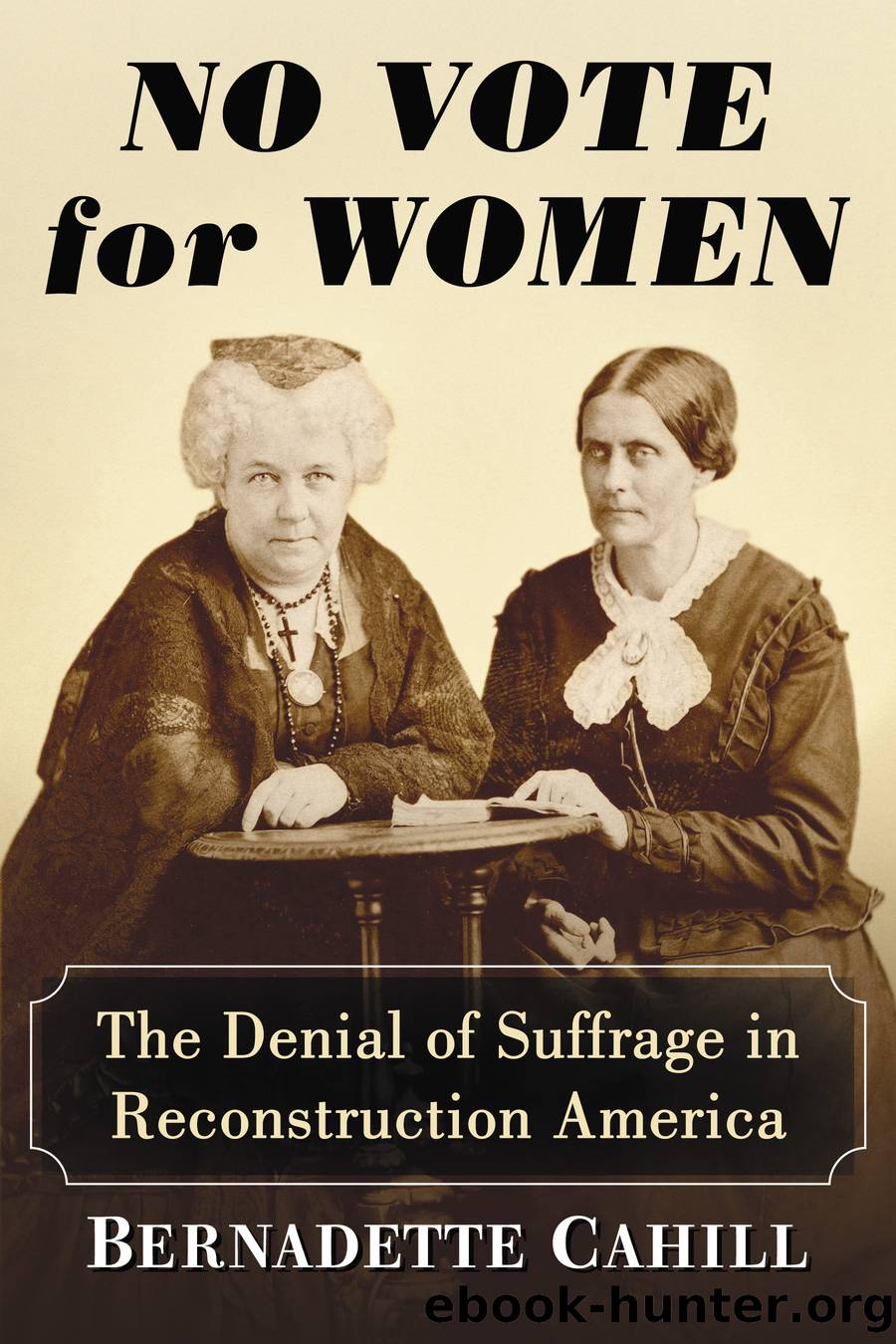
Author:Bernadette Cahill
Language: eng
Format: epub
Publisher: McFarland & Company, Inc., Publishers
Published: 2020-01-24T00:00:00+00:00
26. Reinforcements
What I have had to do with is the inconsistency and hypocrisy of those who advocate negro suffrage and oppose Woman suffrage; the inconsistency and hypocrisy of those negroes who claim rights for themselves that they are not willing other human beings with equal intelligence should also enjoy.âSamuel N. Wood, 1867, History of Woman Suffrage, II (1887), 230â231.
On August 9âthe same day Anthony wrote to Wood in Kansas about the latest financial debacle affecting the campaignâEmporiaâs suffrage women, at a meeting with Bisbee and Wood, found the big guns of local leaders trained on them. On August 13 there would be an anti-female suffrage assembly in the town. That day, âH.C. Cross presided, and large delegations were present. Speeches were made by C.V. Eskridge, Dr. Hewitt, Rev. Mr. McAnulty, J.C. Fraker and Jacob Stotlerâ¦. Messrs. C.V. Eskridge, C.C. Deweese and J.D. Jaquithâone from each representative districtâ[were appointed] to act as a central committee to organize the county against the imported and homeâ campaigners.1 âImpartialâ suffrage meetings were also announced for August 15 and 16 for White Cloud and Brown County,2 while a call went out for a âMeeting of the Opponents of Female Suffrageâ for Emporia for August 31. Seventy-seven names declared, âAll who are opposed to Female Suffrage and believe that the best interest of the people of Kansas demand the defeat of the proposition now before them, are requested to unite with the undersigned in mass meeting.â3 The men of Emporia thus took direct aim at the âuppityâ Browns, Bisbees, and Anthonys from elsewhere, while directly challenging local women who had demonstrated with their work and petition that they did not know their proper place. The August 9 meeting in Emporia with Bisbee and Wood speaking was the last sighting of Wood for several weeks. Sought out later, he said he had become disheartened and retreated home.4 The timing of Woodâs exit is close to when he likely received Anthonyâs letter about the Jackson Fund. His disappearance from the SISA scene in August 1867, therefore, may signal yet another impact on the Kansas campaign by Phillips and the male judicial system that resulted in the loss of the womenâs trust fund, for Wood had jump-started and promoted the SISA campaign and without his leadership, the campaign stumbled. Blackwell had warned about this in the spring.5
Meanwhile, the anti forces, in heavily sarcastic prose, increasingly complained at every opportunity of anything they disapproved of about the women. They attacked Bisbeeâs suffrage work and the singing troupe who provided entertainment for people living in isolated communities where entertainment was rare: âWhat a compliment to the people of Kansas it is to send boarding school misses and crazy singers to instruct them in their political duties. The people who canât be converted by Miss Bisbee and the Hutchinsons will, we presume, be turned over to Sam Wood, who will blackguard them into the support of Female Suffrage! Quite a dignified way of treating a delicate and important subject! What next?â6 This mud was mild compared with that previously thrown at the womenâs cause.
Download
This site does not store any files on its server. We only index and link to content provided by other sites. Please contact the content providers to delete copyright contents if any and email us, we'll remove relevant links or contents immediately.
The Vikings: Conquering England, France, and Ireland by Wernick Robert(84377)
Ali Pasha, Lion of Ioannina by Eugenia Russell & Eugenia Russell(40317)
The Conquerors (The Winning of America Series Book 3) by Eckert Allan W(37951)
The Vikings: Discoverers of a New World by Wernick Robert(37006)
Cecilia; Or, Memoirs of an Heiress — Volume 1 by Fanny Burney(32636)
Cecilia; Or, Memoirs of an Heiress — Volume 2 by Fanny Burney(32010)
Cecilia; Or, Memoirs of an Heiress — Volume 3 by Fanny Burney(31996)
Empire of the Sikhs by Patwant Singh(23135)
The Secret History by Donna Tartt(19293)
Hans Sturm: A Soldier's Odyssey on the Eastern Front by Gordon Williamson(18649)
Cat's cradle by Kurt Vonnegut(15441)
Pimp by Iceberg Slim(14664)
Sapiens: A Brief History of Humankind by Yuval Noah Harari(14458)
Norse Mythology by Gaiman Neil(13457)
Talking to Strangers by Malcolm Gladwell(13439)
Leonardo da Vinci by Walter Isaacson(13411)
4 3 2 1: A Novel by Paul Auster(12509)
Underground: A Human History of the Worlds Beneath Our Feet by Will Hunt(12144)
The Radium Girls by Kate Moore(12090)
